Sunday, 21 March 2021

Insurance defined: The business of insuring against loss.

Insurance is something we are all familiar with. Love it or hate it (depending on whether your are the buyer or the seller) it is a necessary fact of life.

I, like you, have many different insurance policies; life insurance, house insurance, auto insurance, health and dental insurance and as I own an airplane, yes that too is insured. 

And that is what has my hair on fire tonight. It is renewal time again, something that seems to happen more often but the paper work says no. It is only once a year. I have owned and insured this particular plane for 30 years, all of which have been accident/claim free and yet my rates keep going up. 

This year it is an astounding 23% increase. Is there no reward for flying safely, paying exorbitant rates for fuel, $1.60 per litre, buying the latest safety equipment and maintaining the beast to ever increasing standards at ever increasing costs?

At what point does it become uneconomical? During the last 12 months, I flew just 17 hours. This due to COVID restrictions as we were not permitted to fly south to the US and were discouraged from travelling within the province as well. That pretty much restricted us to the circuit and a nearby practice area in order to maintain some semblance of competency. Yes, that is important in order to be safe and continue the claim free status. Using those numbers, each hour flown cost $100 just for insurance. With a fuel burn of 12 US gallons (45 litres) an hour, that is another $72.00 for fuel. Then you need to set some aside for maintenance and of course there is the hangar cost as well. It is getting a little pricey, eh what?


Friday, 5 March 2021


The New Normal –what will it be?

As I write this in late January in the midst of the uncertainty about COVID vaccine deliveries and a flattening but not declining incidence of infection, I wonder what 2021 will bring. When will we get back to enjoying life as we knew it “back then”? Everyone is concerned, especially those of us over 70. Uncertainty is the norm as no one let alone the politicos has a clue as to what tomorrow will bring.

The feds have sealed our borders, limiting flights into Canada, travel to the US and even closing the Caribbean to travel. I guess that means my frequent flyer points will continue to accumulate in spite of a desire to get out of town.

We can’t go to church or have a strata meeting. Everyone is told to stay home. No birthday or anniversary parties and even no funerals. Stores are closing permanently and the mall seems empty – because it is. Retailers can’t get inventory as shipments from China have been reduced. Perhaps in the long term that could turn out to be a blessing. Maybe Canadians will start making things once again. Come to think of it, making vaccines would be good.

Fear is everywhere. People are wearing masks in malls and stores, and even when outside or in their car and alone. It is difficult to read someone’s expression through a mask. Some are even wearing two masks based on the theory that if one is good, two must be twice as good.

TV programs are buying into this as well, with the characters wearing masks and making it hard to understand what they are muttering about – especially if you are a bit “hearing impaired”.

Virtual meetings are the current reality and the only option but they really don’t provide a good substitute for the real thing.

Will the vaccine bring relief from all of this? If we are to believe that then we also have to believe that another summer is lost as it won’t be till fall that all have received their shots.

I don’t have the answers, just more questions.

Thursday, 18 February 2021


With the aid of Jack Scofield of Coast Dog Press, Mayne Island BC,  a pilot, author, editor and all round capable good guy I have published a book about the things I like best - People Places and Planes. and it is available for shipment within Canada for $39.95 - higher in the US and other locales due to postage costs.


Thursday, 31 January 2019

FLYING IN THE LOWER MAINLAND OF BRITISH COLUMBIA

FLYING IN THE LOWER MAINLAND OF BRITISH COLUMBIA
Vancouver VTA VFR Terminal Area Chart

Flying in the lower mainland of British Columbia can be a wonderful experience with the views of the scenic snow covered coastal mountains just to the north and the Strait of Georgia to the west. It also can be challenging for a visiting private pilot. The area is relatively small, hemmed in by 5000 ft. mountains to the north and by the US border to the south; a triangle 65 miles deep and just 20 miles wide at the base. In that triangle are a number of airports ranging all the way from a busy international airport to a number of private grass strips.

On the west edge is the busy Vancouver International (YVR) with over 800 movements every day. Located just to the south of YVR is the Boundary Bay airport, itself a busy training field with constant student movements. Just 2 miles east of Boundary is Delta Airpark, a small grass strip that is home to a Recreational Aircraft Association chapter. Just north of YVR is the Vancouver Harbour, also busy with numerous scheduled float operations. East of there is the Pitt Meadows airport with just 2 miles separating its control zone from that of Langley. Pitt and Langley both have a high volume of students in addition many resident private aircraft. To the east of Langley is Abbotsford International with a growing number of scheduled airline flights and yet even more students and private aircraft. Are you detecting a theme here? BC has become a significant centre for flight instruction with students from around the world. If you extend out a bit further east up the valley, it gets a little quieter where you will find Chilliwack and finally at the apex of the valley, Hope, a well-known venue for gliders.

Considering all of the airliners above, towns and cities below and student pilots in-between; it can be a very busy place to fly. Keeping a sharp lookout is always the order of the day as is listening out on the frequency of the nearest airport or practice area. With so many students in the air it is important to give them some space. After all, they are learning just as you did once (and with any kind of luck – still are).
On a beautiful sunny day it seems incongruous to have a GPS turned on. I mean after all how can one get lost in such a small area? Well, with overlapping control zones, it is very important to know exactly where one is at any time. I know this from experience, having had the phone call wanting to know why I had “busted” a zone without talking to anyone. (I think my right wing tip may have been over the line)
Even with all of this congestion, there are still lots of places to go and play. We can dip our toes into mountain flying with short trips up three local lakes; Harrison, Stave and Pitt lakes all are within a few minutes flying time and any would make a great trip as an intro flight if you have a guest or wannabe pilot along for the ride. The north shore route to Howe Sound and the Sunshine Coast is bordered by mountains with views of Stanley Park and metro Vancouver.

For the more adventuresome, they can extend out to Vancouver Island and find even more to see and do. Just remember the flight plan and the life jackets for the over-water portion.

Canadian Museum of Flight


CANADIAN MUSEUM OF FLIGHT
Langley BC airport CYNJ

Hidden on a side street at the Langley airport is a small museum with a large heart for promoting and preserving BC’s aviation history. You might say “It’s the little museum that could – and does”. Located between a flight school and a row of private hangars, it struggles for both recognition and visibility.

The Canadian Museum of Flight is located at CYNJ, having arrived there in 1996 after having spent the first 20 years of its existence in White Rock BC. At that site they had a 600 ft. grass runway that permitted flying only their smaller aircraft.
The museum is owned and operated as a not for profit society by a volunteer board of directors and a small but dedicated staff.
Snowbird #8
It is currently situated in Hangar #3 on the south side of the airport where their display includes a large number of static aircraft as well as several that are maintained in flying condition. They are able to fly a Fleet Finch*, an SE5A replica, A Sopwith Pup replica as well as a Fleet Canuck.

A stroll through the outdoor display reveals a number of 1950’s era jets, such as a CF104, CF100, T-33 and a DH Vampire. Another well-known Canadian aircraft is a Tutor painted in Snowbird colours. Piston engine aircraft on display run the gamut from a Handley Page Hampden, a DC-3, Conair Fire-cat, Beech 18 Expediter 
CF100
all the way down to an 18 hp composite Quickie. Each and every one has a story to tell and the volunteer docents are willing to spend the time to do so.
The entrance to the museum is where you will find a well-stocked gift shop with an excellent selection of books and magazines.
A very busy place indeed
Inside the hangar you will discover numerous displays of engines, uniforms and medals and all of the fabric covered aircraft that must be accommodated inside due to weather concerns. There are also several restoration projects that are currently underway in the hangar.
All of this is maintained and supported by a cast of volunteers who meet weekly to help with the myriad of tasks that are required to run such complex facility.
Plans are underway to relocate to a new, yet to be built building on the west side of the airport when sufficient funds are raised to support the project.
For more information and their hours of operation, check out their web site at:

*the writer has flown this Finch for 16 hours during displays in 2000 and 2001.

Friday, 4 May 2018


A JANUARY PHOTO SHOOT

It all started with a phone call the night before telling me to be at the airport for an 11:00 briefing for a long awaited photo shoot. The subject was a recently re-restored 1938 Beechcraft SD17S Staggerwing owned by a retired businessman from West Vancouver. We wanted to get some air to air shots for a magazine article and this was the first day that both the weather and everyone’s schedules coincided. The plan called for using a Robertson helicopter, a 4 place R44 as the camera ship as we could take the doors off for unrestricted sightlines. It seemed like a good plan, everyone inside and warm except the photographer – me.

Photo ship pilot & owner, Roy Heaps
The air temperature on the ground was -4C[i] with calm winds, sky clear and a million. How can it get any better? I had a borrowed arctic type flight suit and an all Canadian Toque. Gloves were a problem though, if they were to be warm, they’d be too thick to operate the cameras. Oh well, tough it out bare handed and get on with it.

Everyone involved got together and arrangements were briefed for altitude, direction of flight for the best light and the backgrounds, airspeeds and radio frequencies were confirmed. As the R44 cruises at 110, it was agreed by all that the Staggerwing, being faster, would form up on the helicopter as required.
The air was smooth with no wind to speak of. The local mountain peaks were clear with a coating of fresh snow made which made for an excellent backdrop for the bright yellow Staggerwing.
Staggerwing over north shore mountains
During the shoot, the helicopter pilot would yaw the helicopter towards the Staggerwing to help position the shots and this of course put even more cold air into the back cabin. At one point I became concerned when it appeared that I had a camera failure. I switched to a backup camera only to have the same issue. As it happened, both cameras were fine; it was my hands that weren’t. I was losing feeling in my fingers and couldn’t feel the camera controls.  The pain from the cold quickly became unbearable. (See foot note.) However, as we changed locations or the Staggerwing repositioned, I took the opportunity to get the gloves back on and restore some semblance of feeling to my hands.


All went well and as a result, we got the last of the pictures we needed.


[i] A quick check with “Professor” Google, a temperature of -4C and an airspeed of 110 mph = a wind-chill of -43C!

Thursday, 3 May 2018


Reno Air Races


Cottonmouth #20 and the race crew - note the T shirts.
Back in 1991 my friend Jim McRae and I decided to drive from Vancouver to Reno to see the 28th National Championship Air Races and the associated air show. The races featured many well-known pilots, three time winner Lyle Shelton in Rare Bear, Bill Destefani in Strega and Skip Holm in Tsunami. A totally new design, the Pond racer made its debut.  This composite twin designed by Burt Rutan would be flown by Rick Brickert. This unique aircraft powered by two 6 cylinder automotive racing engines fostered hopes of defeating the much larger war bird racers. The daily airshow included such as then current notables as Jimmy Franklin and Johnny Kazian, Joann Osterud, Leo Loudenslagger and of course Mr. R.A. (Bob) Hoover.
Seafury Cottonmouth Race #20
Jim, a longtime volunteer at sports car races and a frustrated race driver at heart drove his new Honda Civic while I navigated. This was the same division of talents that we had refined during long cross country trips in his Champ. There was slightly more trepidation in the Honda than in the Champ however.
We drove straight through to Reno and checked into the Peppermill and slept the sleep of the just and exhausted. I had stayed in the Peppermill numerous times in the past while in Reno on business and while the hotel had the feature of familiarity and good rates, it was also the unofficial hotel for some of the race teams.
After breakfast the next day we bussed out to the race venue at Reno Stead Airport where we purchased the necessary passes including the obligatory "pit pass". It was as necessary to get into the pits as breathing for two aviation nuts. Besides that, we knew one of the unlimited racers and who knew what might come out of that.
A long time friend of Jim's was a former BC Lions football player and war bird owner, Jerry Janes. Jerry and his crew had brought his #20 Hawker Sea Fury, “Cottonmouth” for the race week and as luck would have it, his pit was next to Lyle Shelton's #77 Bear Cat - Rare Bear. Lyle was to win the Unlimited race on Sunday and set a new race record of 481 mph in the process.
Jim wangled our way on to Jerry's pit crew and we were promptly given the “vital” task of polishing the Sea Fury. Polishing this beast to a high gloss was to make a huge difference in the win potential. The Sea Fury is a big plane and the task was made more challenging by the amount of oil deposited by the 2700 hp Curtis Wright 3350-26WD. This task occupied us for most of the weekend. Very little other work was needed as according to the crew chief Russ Popel, “you have to come ready to race, otherwise stay home. “  With the original 2480 hp Bristol Centaurus engine, the Sea Fury had a top speed of over 400 mph and with the more powerful Wright it should be competitive in the Bronze and maybe even in the Silver races This particular aircraft was one of 35 built for the Royal Canadian Navy and still had the wing folding feature and I would be reminded of this fact much later in the weekend.
Pond Composite unlimited racer
The race weekend proceeded with the usual suspects winning their respective classes. Gold on Sunday was won by Rare Bear followed by Strega and Tsunami. The highly touted composite Pond racer suffered an engine fire and pilot Rick Brickert declared a mayday, pulling up and out of the race. This surprised no one in the Unlimited pits as they, the Pond crew, had managed to alienate most of the unlimited teams and so there was little sympathy for their misfortune. At he end of the day, some of the unlimiteds were wearing a "Pond kill" on their cowlings. 
Emotions were running high in the unlimited pits


John Muszala flew “our” #20 Sea Fury to a six place finish in the Silver race as Jerry had come down with a bug on Saturday.
Late Sunday after the end of the Gold race as I was focused on cleaning the last of the oil off the side of the fuselage, I was surrounded by the noise and bustle of the crew as they packed up preparing to go home. Suddenly it started to get dark and I detected movement overhead. I was startled and dropped to the wing walk, fearing that something was about to fall on me. That was not the case as it was just the outer wing panel folding up and over me. Sheepishly I got up and finished my task, thankful that no one had spotted my brief moment of terror.
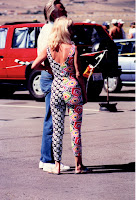

Fans of all descriptons
The ride home on the following Monday must have been uneventful or perhaps I was too tired to care. It was an exciting weekend and an exceptional opportunity to see the races from the inside.